
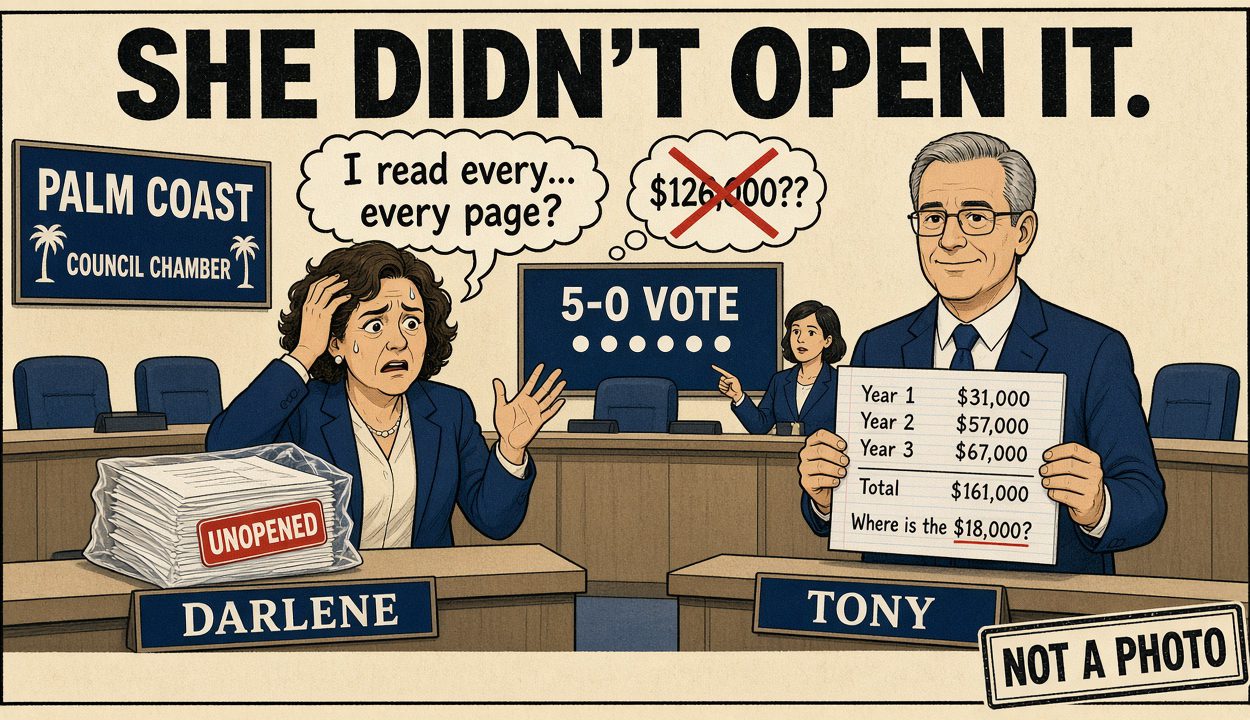
Tony Amaral did not tell the room he had done the reading. On September 1 he stood up and showed it, in about forty seconds.
Palm Coast had pulled one consent item for questions: a piggyback contract for NeoGov software. Training, evaluations, a three-year price. Amaral, running for the District 2 seat, had the agenda on an iPad. He said the staff report had been hard to read. Then he read the only box that mattered, off that screen.
The contract escalates over three years. The report says the city will save $18,000. He gave the years out loud: $31,000, then $57,000, then $67,000, “a total of 161.” He asked whether the savings were for year one or the whole deal, and he noted that the price more than doubles.
| He said | The packet | |
|---|---|---|
| Year 1 | $31,000 | $31,389.75 |
| Year 2 | $57,000 | $57,640.50 |
| Year 3 | $67,000 | $67,247.25 |
| Prorated month | — | $5,552 |
| Total | $161,000 | $161,829.50 |
| Shelley | $126,000 | Not in the item |
His three rounded years add to $155,000. The rest of the $161,000 is the prorated month. He was on the right lines. Then he did the useful part: he would not let “we will save $18,000” sit next to a price that more than doubles without someone saying saved against what, and in which year.
Nine seconds earlier
Darlene Shelley, running for District 4, said the packet was 1,421 pages and that she had read every one. The page count is right. The number she brought back is not. She believed the contract was $126,000 and asked twice whether that was one year or all three. She had also looked into “whoever this Omnia is.” Omnia Partners is the cooperative the piggyback runs through. NeoGov is the vendor.
The mayor called staff. Doug never mentioned $126,000. He answered Amaral. The city already uses NeoGov to hire. Training sits with Vector Solutions, at about $36,000. Moving it saves $18,000 in year one. The savings shrink after that. By year three, training costs about what the city pays now. The contract also moves employee evaluations into NeoGov. The council voted 5–0.
Staff answer, 0:53:25 · The 5–0 vote
The answer matched his question. Her number never came back.
He does this on ordinary nights
- April 21 A 557-page packet had come out Friday. He asked for it earlier, and joked that he is the resident who actually reads it.
- July 14 Revenue up about 13.5 percent. Expenses up about 18.5.
- July 21 He backed a land sale and still asked for a right of first refusal if the project died, then asked the city to put that protection into contracts before they reach the dais.
Twenty-two turns, eleven meetings, twelve of them a question. Of 110 claims checked, 53 were supported and 22 mostly supported. One was marked contradicted and is still awaiting review.
The price on this item was printed. She said she had read every page, and asked the city to interpret a number the page does not contain. He recited the page, then asked where the savings were.
If her $126,000 was the yearly cost, three years would be about $378,000. If it was the total, the deal would be a third smaller than the truth. People at home left her comment with a budget the council was not voting on. They left his with the budget that passed.
September 1 was the night those two habits stood nine seconds apart. She said she had read every page. He had the packet open on an iPad and read the fiscal box. The city answered him.


Leave a Comment