
Most people will not read a full budget report. They will remember one question:
If County Commission is truly careful with taxpayer money, why does spending keep rising while problems keep growing?
That question is becoming harder to ignore.
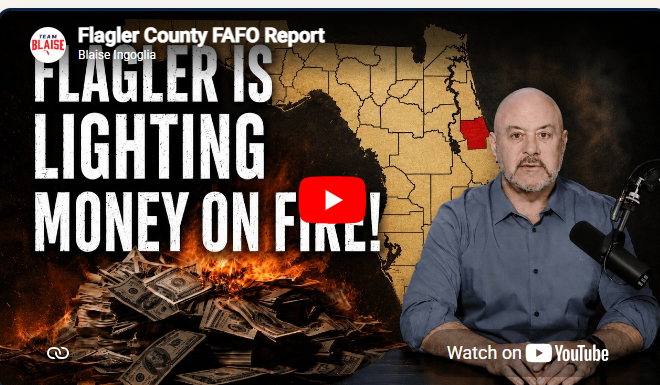
Florida Chief Financial Officer Blaise Ingoglia recently reviewed local government spending and said Flagler County had the largest budget increase of the counties studied. The county’s general fund grew by $110.2 million from 2019–2020 to 2025–2026. He warned that this level of growth “should concern every single taxpayer.” His office also said the county could lower taxes by 1.40 mills without cutting essential services.
That matters because the Flagler County Commission continues to present itself as fiscally conservative and protective of taxpayer dollars. But over the past two to three years, the record shows something different:
- Rising budgets
- Costly projects with weak planning
- Service cuts despite new spending
- Expensive leadership turnover
- Growing long-term financial obligations
The issue is no longer messaging. It is performance.
The Gap Between the Message and the Math
Flagler County’s 2025–2026 budget totals $335.8 million, with a general fund of $202.7 million. At the same time, the Commission approved a tax rate 4.98% above the rolled-back rate. That means taxpayers are funding a larger government—even while being told the county is holding the line on taxes.
Ingoglia has been clear in his broader message: “The days of unchecked spending are over.”
Flagler County is now part of that conversation.
The Commission’s Position vs. Actual Outcomes
The Commission has consistently emphasized fiscal restraint, skepticism of new taxes, and responsible stewardship.
However, recent public statements also acknowledge that certain spending decisions—such as the Nexus Center project—may have been premature or could have been delayed.
That creates a central issue:
If major expenditures are later described as avoidable, what does that say about the Commission’s decision-making process at the time those decisions were made?
Example 1: The Nexus Center Problem
The Commission approved a $14.4 million contract for the Nexus Center library in 2024. By 2026, the project cost had grown to about $16.6 million. At the same time, in 2025, the county cut library hours by about 23% at another location due to staffing limits. This highlights the core issue: The Commission approved a major capital project without fully aligning long-term operating capacity. Taxpayers funded expansion, but service levels still declined elsewhere.
Example 2: Leadership Turnover Costs Taxpayers
In early 2026, the county experienced significant administrative instability:
- A deputy county administrator resigned after roughly three months
- County Administrator Heidi Petito resigned shortly after
Petito stated:
“Tension among the Board members has been building… and it has begun to affect our employees and the organization.”
This is not simply internal conflict. It represents a measurable cost to taxpayers resulting from Commissions hostile approach toward staff.
Example 3: Budget Growth With Ongoing Deficits
In June 2025, staff reported a need to close a $2.9 million budget gap. This raises a key concern:
How does a government with substantial budget growth continue to face recurring shortfalls?
This pattern suggests the Commission’s lack of financial planning or reliance on professional staff, rather than political decisions.
Example 4: Unfunded Long-Term Obligations
In January 2026, the Commission identified significant ongoing financial pressures:
- $14 million annually needed for stormwater maintenance
- $5.1 million annually needed for roads
- $77 million in unfunded capital projects
- A $114 million beach management plan requiring new funding
These obligations remain largely unresolved. The Commission cannot credibly position itself as fiscally conservative while carrying this level of long-term financial exposure.
Example 5: Growth in Administrative Staffing
The state review also found that Flagler County added:
- 80 full-time administrative employees
- During a population increase of 32,564 residents
Population growth requires expanded services. That is expected. However, the Commission has not clearly demonstrated how this administrative growth directly translates into improved service delivery or efficiency.
The Broader Political Pattern
The Commission has frequently emphasized “low taxes” and fiscal restraint. However, the record shows a recurring pattern:
- Messaging focused on tax rates
- Decisions that increase total spending
- Deferred or underfunded infrastructure obligations
This creates a disconnect between public messaging and actual financial outcomes.
The issue is not whether the Commission uses the language of fiscal responsibility.
The issue is whether its decisions consistently reflect that standard.
Over the past several years, the Commission has:
- Increased overall spending
- Approved projects later questioned in hindsight
- Reduced service levels despite capital expansion
- Incurred costs tied to administrative turnover
- Continued carrying substantial unfunded obligations
How will the Commission respond.

Leave a Comment