On the morning of April 27, 2026, 11-year-old Nolan left for school the way he always did. His mom, Ashley Lugo, said the last glimpse she had of him was at the bus stop, laughing and messing around with his friends. A few hours later, everything had changed; he was suddenly fighting to stay alive.
Nolan had an AVM in his brain, and nobody knew it existed. That morning, it ruptured.
From a normal day to a full-blown emergency
Ashley said the school’s first call sounded routine; they wanted permission to check Nolan’s blood sugar. Then, about 30 minutes after that, another call came in, this time asking if they could get him to the ER right away. Nolan had passed out. Before that, he’d started talking in a way that didn’t make sense, clutched his head and screamed, then had a seizure and slipped into a coma.
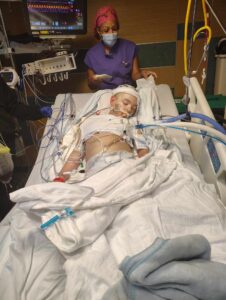
He was flown by helicopter to Orlando AdventHealth. There, Dr. Keyne Johnson and the pediatric ICU team worked to keep him alive. Surgeons had to act fast to bring down the swelling and pressure inside his skull. They put in a drain, and they removed the right side of his skull; doctors said it was the only way because the bleeding from the ruptured AVM wouldn’t stop and the pressure in his brain kept climbing.
Nolan remained in a coma from late April into May. When doctors eased back the sedatives, he still didn’t wake up. Ashley said tests showed no brain activity, his eyes didn’t respond to light, and he didn’t react to pain; in her words, he “clinically looked brain dead.” The family had more than one conversation with doctors about brain death, and preparations were made for further testing. One doctor, she said, told her that if he had to guess, he didn’t think Nolan would come back.
And then, about five days later, his eyes started responding to light.
Not long after that, he began moving them. He wiggled his right hand. He kicked his right foot. Ashley said it felt like watching him start over from the beginning. “He was like a newborn baby again,” she said, “but an 80-pound newborn baby.” He couldn’t hold his head up. Sitting up wasn’t possible. Eating wasn’t either; he needed a feeding tube.
What an AVM is
An AVM, short for arteriovenous malformation, is a blood-vessel abnormality in the brain. Ashley described it as “an abnormal cluster of blood vessels,” basically a knot of arteries and veins tangled together. When blood pressure rises, that knot can burst. Nolan’s was small, about a centimeter. “It’s insane to me that something so tiny can cause such damage,” she said.
The long recovery, and the hard parts that come with it


Nolan stayed in the hospital until early June. After that, he spent three weeks at Brooks Rehabilitation in Jacksonville as an inpatient. He started speaking while he was there, though Ashley said the physical gains came slowly. Now he goes to a Brooks day program five days a week. She said he has started using his left leg again. The left side of his body had been paralyzed, and his left arm still isn’t moving. He’s also begun eating again.
Cognitively, Ashley said he’s doing well overall. Still, he’s dealing with short-term memory loss, confusion, and a limited attention span, the kind of issues she believes therapy can keep chipping away at.
The obstacles didn’t stop once he was making progress. On July 14, surgeons put his skull bone back in place. Around two weeks later, he had to be flown back to the Orlando hospital because he developed “subclinical,” or silent, seizures- seizures you can’t see, but that can still harm. Doctors are testing different anti-seizure medications, including Keppra and Depakote, hoping to land on something that works. Ashley said the side effects can be brutal: grogginess, exhaustion, muscle weakness, and more trouble with memory and focus.
A decision no parent wants to face
The AVM is still there. It’s deep in the right thalamus, close to the brainstem. Ashley said one surgeon told her it’s too deep to remove, and that the remaining option would be gamma knife, a targeted radiation treatment. But a gamma knife doctor warned her it could create new injury and wipe out the progress Nolan has fought for.
In September, the family plans to go to Miami for another opinion with Dr. Abla, who Ashley described as a University of Miami neurosurgeon. She said she’s praying someone sees a different path forward, because both surgery and radiation in that area can carry major risks. Doctors have also told her Nolan’s chance of another rupture is high, given where the AVM sits and how young he is.
When people ask how long recovery will take, Ashley said there isn’t a real answer. “There literally is none,” she said. Every case is different, doctors have told her. Nolan might continue improving for the rest of his life, or he may not move much beyond where he is today.
A family trying to hold everything together
Ashley said she can’t work anymore. She’s Nolan’s full-time caregiver now, his advocate, his driver, while also raising three other kids. Nolan sees a long lineup of specialists: neurologist, neurosurgeon, urologist, and more, and it can feel like appointments take up most days. Therapy is the priority, Ashley said, and that often means afternoon drives from Palm Coast to Jacksonville.
Expenses keep stacking up: gas, travel, medications, equipment, therapy. On top of that, the family needs to move. Ashley said the rental home they’re in has problems the landlord has been slow to address, including a broken air conditioner that left the house around 90 degrees for roughly four days. That kind of heat is dangerous for Nolan, she said, because he can’t regulate his body temperature. They’re searching for a three-bedroom rental and will need help with the move.
Ashley said they’ve created a GoFundMe and appreciate support in any form, financial help, gas cards, and assistance from local businesses or organizations.
Even with everything happening, she said, Nolan keeps pushing. “He’s a fighter, and he understands what happened to him,” Ashley said. “He smiles every day.” She added that there are tough days, but most of the time he’s happy and grateful for the people who’ve already shown up for their family.
As she put it: “This isn’t a story about a child who simply survived. It’s about a child who survived something devastating and is now fighting every single day to get his life back.” To help this family as they fight for Nolan’s health and recovery, you can visit their GoFundMe here. If you would like to donate a service to help the family, you can reach out to Ashley via her Facebook page here.
The post Palm Coast Boy, 11, Fights to Recover After a Brain Bleed No One Saw Coming first appeared on Flagler County Buzz.